

A fridge freezing food is almost always fixable — and rarely means a major repair. This guide covers every common cause, from a nudged temperature dial and blocked vents to a stuck air damper, failed thermistor, or ice maker running without a water line. Work through each fix in order and most problems resolve without calling a technician.
You open the fridge for some lettuce and find a green brick. The milk is slushy. A container of leftovers has turned into a solid block overnight. If your fridge is freezing food, it’s one of those problems that feels minor until it isn’t — wasted groceries, ruined ingredients, and a low-level worry that something expensive is wrong with the appliance.
Here’s the good news: a fridge freezing everything is almost always fixable. Most of the causes are well understood, and plenty of them don’t require a technician or a single tool. This guide covers every reason your refrigerator is freezing food — from a nudged dial to a failed component — and what to do about each one.
In This Article
- What’s the Right Temperature for a Refrigerator?
- The Most Common Reasons Your Fridge Is Freezing Food
- Why Is Food Freezing Near the Back or Top of Your Fridge?
- Is Your Door Seal Letting Warm Air In?
- The Air Damper: The #1 Mechanical Cause of Fridge Freezing
- Thermistor and Thermostat Failure
- The Hidden Cause Nobody Checks: Your Ice Maker
- Whirlpool Refrigerator Freezing Food? Here’s Where to Start
- Frequently Asked Questions
- What to Do When Your Fridge Won’t Stop Freezing
What’s the Right Temperature for a Refrigerator?
The answer is simpler than most people think: your fridge should sit between 35°F and 38°F (1.7°C to 3.3°C). The FDA recommends keeping it at or below 40°F to slow bacterial growth, and Consumer Reports pegs 37°F as the practical sweet spot. That’s your target.
The problem is that 35°F and 32°F — the freezing point of water — aren’t that far apart. Set your fridge a couple degrees too cold, and any slight airflow variance near the vents can push food right past freezing. A refrigerator too cold by even a few degrees is enough to turn lettuce to mush and milk to slush.
Most fridges use a numbered dial instead of actual degree readings, which makes this worse. A dial set to “5” on a 1-to-7 scale isn’t a temperature — it’s a guess. If your fridge is freezing my food and you haven’t verified the actual temperature, that’s step one. A cheap fridge thermometer placed on the middle shelf gives you a real reading in about 15 minutes.
| Temperature Range | What Happens | Status |
|---|---|---|
| 38°F-40°F (3°C-4°C) | Food stays fresh, bacteria growth slowed | Ideal zone |
| 35°F-37°F (1.7°C-3°C) | Acceptable; sensitive items may get very cold | Slightly cool |
| 33°F-34°F (0.5°C-1°C) | High-moisture items at risk near vents | Too cold |
| 32°F (0°C) and below | Food begins freezing; cellular damage to produce | Freezing zone |
| Above 40°F (4°C) | Bacterial growth accelerates; food spoils faster | Too warm |

The Most Common Reasons Your Fridge Is Freezing Food
What causes a refrigerator to freeze up? In most cases, it’s one of seven things. Some are user-adjustable in five minutes; others involve a failing component. Here’s the full list before we dig into each one.
- Temperature setting too low
- Food or containers blocking the air vents
- Damaged or dirty door gasket
- Air damper stuck open
- Faulty thermistor or thermostat
- Ice maker running without a water connection
- Failed defrost system causing frost buildup
Why is fridge freezing food such a common complaint? Because your fridge doesn’t generate cold air in the fresh food section — it borrows it from the freezer. Cold air flows from the freezer through a controlled vent into the refrigerator compartment, circulates, and returns. Anything that disrupts that loop — too much air in, a sensor that can’t detect the real temperature, a vent that won’t close — turns a 37°F fridge into a secondary freezer.
And that’s just one part of it. Refrigerator freezing food problems can compound: a bad door seal makes the compressor run longer, which pushes more cold air through a damper that’s already slightly stuck. One issue becomes two. That’s why the fix order matters, and why we’re starting with the easiest checks first.
Why Is Food Freezing Near the Back or Top of Your Fridge?
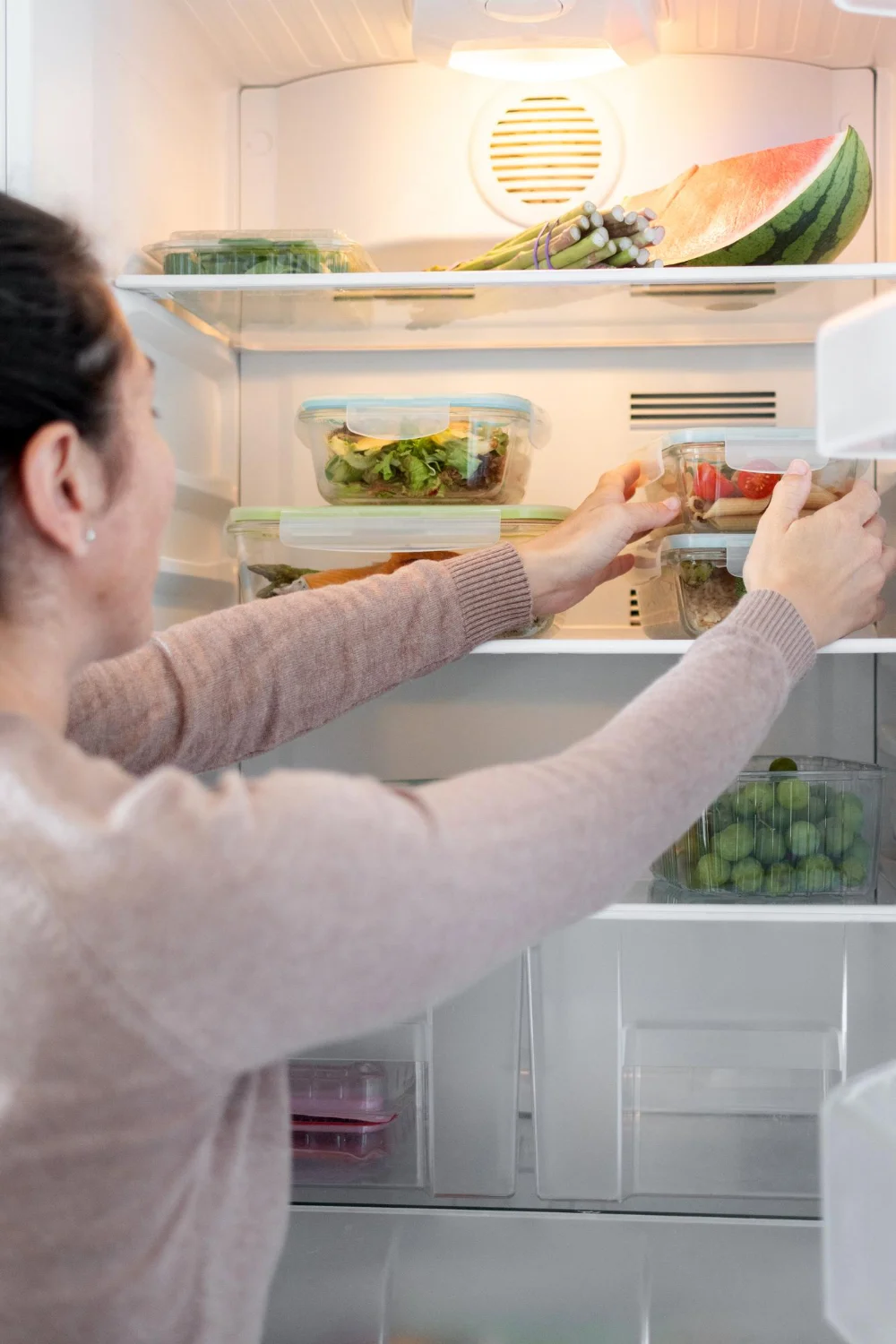
If food is specifically freezing at the back of your fridge or on the top shelf, the location tells you a lot. Cold air from the freezer enters the fresh food compartment through a vent at the upper back wall. Anything sitting directly in that airstream gets hit with air that’s close to 0°F — straight from the freezer evaporator. That’s why my refrigerator is freezing food on the top shelf is one of the most searched variations of this problem.
The fix here is often just rearranging what’s on that shelf. Move eggs, dairy, and anything water-dense away from the back wall and the upper vent. Keep at least two to three inches of clearance around the supply vent so that cold air can disperse properly before it reaches your food. High-moisture items like lettuce and celery should go in the crisper drawers, which sit lower and further from the direct airstream.
But here’s the thing: if you’ve moved everything and food is still freezing near the back or top, the vent itself might be the problem — specifically the damper that controls how much air flows through it. We’ll cover that in a separate section. For now, check that nothing is blocking the vent and that no containers are pressed flat against the back wall, which is where the evaporator coil or return air path sits in many models.
- Move high-moisture produce (lettuce, celery, herbs) to the crisper drawers
- Keep 2-3 inches of clearance around the upper back vent
- Don’t press containers flat against the rear wall
- Avoid stacking items so high they block airflow between shelves
- If freezing persists in the same spot after rearranging, check the damper next
Is Your Door Seal Letting Warm Air In?
A damaged door gasket is one of the sneakier causes of fridge freezing everything, because the logic feels backwards. A leaky seal lets warm air in — so why would that make things freeze? Here’s why: the thermostat detects the warmer temperature and signals the compressor to work harder and longer. The areas closest to the air supply vent get flooded with extra cold air. Fridge freezes everything near the vents while the spot near the leak stays weirdly warm.
The paper test is the standard check. Close the fridge door on a sheet of paper, then try to slide it out. If it pulls free with little resistance, the seal at that spot isn’t making proper contact. Walk the paper around the full perimeter of both doors. Gaskets fail unevenly — the bottom corners and the hinge side take the most wear.
Dirty seals can sometimes be rescued. Clean the rubber gasket with warm soapy water and a soft cloth. Sticky residue causes the seal to pull away from the frame and tear over time. If the gasket is visibly cracked, torn, flattened, or deformed, cleaning won’t help — replacement is the only real fix. Replacement gaskets for most brands run $25 to $60 online, and installation is typically just a matter of pressing the new one into the door channel.
“Cold air must circulate around refrigerated foods to keep them properly chilled. Avoid overpacking your refrigerator — blocked airflow is one of the most common causes of uneven cooling.”
U.S. Food and Drug Administration, Refrigerator Thermometers: Cold Facts about Food Safety
The Air Damper: The #1 Mechanical Cause of Fridge Freezing
The air damper is the small flap or door that sits inside the vent connecting your freezer and fresh food compartment. Its job is to open and close based on how cold the fridge section needs to be. When it’s working right, you barely know it exists. When it sticks in the open position, freezer air at roughly 0°F pours directly into your fridge with nothing to stop it. That’s the most common single mechanical reason food freezes in refrigerator compartments.
Here’s where it gets interesting. The tell-tale symptom of a stuck damper is specific: your freezer works perfectly, maintains the right temperature, makes ice just fine. But the fridge section drops below freezing. It’s not a general cooling problem — it’s localized overcooling from unregulated airflow. If the freezer is fine but the fridge is freezing everything, the damper is the first component to check.
To inspect it, find the vent at the upper back of the fresh food compartment. Hold your hand in front of it. If you feel a constant, strong blast of very cold air even when the fridge is already cold, the damper isn’t closing. Some models have a visible plastic flap you can see through the vent grille; if it’s stuck wide open or visibly broken off its hinge, the assembly needs replacement. The part typically costs $20 to $50 and is accessible from inside the fridge in most models without removing panels.
- Freezer temperature is normal but fridge is below freezing: strong damper indicator
- Constant strong cold airflow from the upper back vent even when fridge is already cold
- Visible plastic flap stuck open or physically broken
- Ice or frost buildup around the vent opening
- Problem started suddenly rather than gradually getting worse
Thermistor and Thermostat Failure
Why does my refrigerator freeze my food even when everything else seems fine? If you’ve checked the settings, the door seal, and the damper, the answer is usually the thermistor — the small temperature sensor that tells the control board what’s actually happening inside the fridge. A failing thermistor can report that the fridge is warmer than it really is, which causes the compressor and evaporator fan to run continuously. The fridge keeps getting colder while the control board thinks it’s still working to hit 37°F. The result is all-shelf freezing, not just near the top vents.
Worth pausing on that for a second, because this is where the ifixit case study is instructive. A KitchenAid (Whirlpool) owner replaced their thermistor as the first fix. The fridge still froze food. They replaced the control board. The fridge ran too warm. They went back and tested the new thermistor — it was reading 10K ohms when it should have read 28K ohms. The replacement part was faulty out of the box. Reinstalling the original thermistor with the new control board finally fixed it. The lesson: test components, don’t just swap them.
Testing a thermistor requires a multimeter. Disconnect the fridge from power, locate the thermistor (usually behind a small panel on the back or side wall), and submerge it in an ice-water bath at 32°F. Whirlpool thermistors should read approximately 16,600 ohms at 32°F. If the reading is significantly off or doesn’t change as temperature changes, the thermistor is faulty. On older models, a mechanical thermostat replaces the thermistor — you can test that by rotating the dial fully from low to high and listening for a click. No click means it’s likely stuck.
| Component | Symptom | Test Method | Est. Part Cost |
|---|---|---|---|
| Thermistor (NTC sensor) | All-shelf freezing, compressor runs constantly | Multimeter resistance in ice bath | $10-$30 |
| Mechanical thermostat | Compressor won’t shut off at any setting | Listen for click when rotating dial; continuity test | $15-$40 |
| Air damper assembly | Freezer fine; fridge section freezes | Visual + feel for constant cold airflow | $20-$50 |
| Main control board | Multiple components misbehaving; error codes | Diagnosis of elimination after testing other parts | $80-$200 |
| Door gasket | Localized freezing near vents; warm spot near seal | Paper test around full perimeter | $25-$60 |
The Hidden Cause Nobody Checks: Your Ice Maker
Here’s the part most people miss. If your ice maker is switched on but not connected to a water supply line, it keeps trying to make ice — and keeps calling for cooling to do it. The control board receives a continuous signal that the ice mold hasn’t reached the harvest temperature, so it runs the compressor and fans without stopping. That aggressive cooling cycle drops the temperature in the entire fresh food section, not just near the freezer. Why is everything in my fridge freezing? Check the ice maker before you do anything else.
The fix is quick: either connect the ice maker to a water line, or switch it off. Most models have a small power switch on the ice maker unit itself, or a lever arm you can lift to the locked upright position. KitchenAid confirms this is a documented cause of overcooling and the resolution is simply disabling the unit when no water supply is connected. If the ice maker is connected but still causing issues, look for a small reset button on the unit itself — holding it for a few seconds clears minor logic errors in the ejector cycle.
This is one of those fixes that takes two minutes and solves the problem completely. If you moved in with an existing fridge, had a plumber disconnect a water line, or recently moved the appliance, it’s worth checking before opening up any panels or ordering parts.
Whirlpool Refrigerator Freezing Food? Here’s Where to Start
Whirlpool is the most commonly reported brand for fridge freezing problems, partly because it’s one of the most widely owned brands in North America, and partly because Whirlpool also makes KitchenAid, Maytag, and Amana fridges — so a “Whirlpool issue” is actually four brands with overlapping parts and design. If you’re dealing with a Whirlpool fridge freezing food, the diagnostic order is the same as above, but there are a few brand-specific notes worth knowing.
The damper assembly in most Whirlpool models is accessible from inside the fresh food compartment without any tools. Look for the vent at the upper back wall — in many models you can see and feel the flap directly. RepairClinic specifically warns that control boards are frequently misdiagnosed on Whirlpool units — test the thermistor and damper first before replacing the board. A control board replacement on a Whirlpool runs $80 to $200+, while a thermistor is $10 to $30 and takes twenty minutes to swap.
For Whirlpool thermistor testing: submerge the sensor in ice water and it should read approximately 16,600 ohms at 32°F. Significantly higher or lower, or no change as temperature changes, means the sensor is faulty. Many Whirlpool models also have a diagnostic mode accessible through button combinations on the control panel — check your model’s service manual (often available free on Whirlpool’s site or via the model number) for the specific sequence. That diagnostic mode can generate error codes that point directly at the failing component, saving you a lot of guesswork.
Why is my fridge freezing food even on the lowest setting?
If the refrigerator is freezing food at its lowest (warmest) setting, the dial itself isn’t the problem — something else is overriding it. The most likely culprit is the air damper stuck in the open position, which allows a continuous stream of freezer air into the fresh food section regardless of what the temperature dial says. A failed thermistor is the second most common cause: it reports the wrong temperature to the control board, which keeps the compressor running even when the compartment is already below freezing. In some cases, a failed defrost system causes heavy frost to build up on the evaporator coils, which blocks the return air duct and causes cold air to concentrate near the top vents instead of circulating. Start by feeling for constant strong airflow from the upper back vent — that’s the quickest way to identify a damper problem without any tools.
How do I stop my fridge from freezing food?
Work through the causes in order, starting with the easiest. First, check the temperature setting and raise it to the mid-range — 37°F to 38°F is the target — and wait 24 hours before evaluating. Second, move food away from the upper back vent and keep two to three inches of clearance around it. Third, do the paper test on the door seal and clean or replace the gasket if it’s failing. Fourth, check whether the ice maker is powered on without a water connection, and switch it off if so. If none of those resolve it, inspect the damper for constant cold airflow and test the thermistor with a multimeter. Most cases are resolved by one of the first four steps — the component-level fixes are needed less often than you’d think.
Why does my refrigerator keep freezing up even after I adjust it?
Adjusting the temperature dial only helps if the dial is actually the problem. If the fridge keeps freezing up after you’ve raised the setting, there’s a component-level issue that’s overriding the control. The most common causes are a stuck-open damper (which ignores the thermostat entirely and just pumps freezer air in), a faulty thermistor (which gives the control board bad data so it never knows the fridge is cold enough), or a defrost system failure (where frost on the evaporator causes uneven, concentrated cold zones and the fridge keeps freezing up inside). One diagnostic shortcut: if the freezer is maintaining its temperature correctly but the fridge section is freezing, that combination points strongly to the damper. If both sections are running extremely cold, the thermistor or control board is the more likely culprit.
Why is my fridge freezing food on the top shelf specifically?
The top shelf is directly in the path of cold air entering from the freezer through the upper back vent. If food is freezing only there, the issue is usually either food placed too close to that vent, or the damper supplying more air than it should. Move items away from the back wall and vent, and check that nothing is blocking the vent itself. If a specific spot on the top shelf freezes everything placed there regardless of arrangement, the damper is the suspect — feel for a constant cold blast from that vent even when the fridge has been running for a while and should already be at temperature. In some models, frost buildup from a failed defrost system can also direct cold air abnormally toward the top of the compartment.
Why is my fridge suddenly freezing everything when it was fine before?
A sudden onset — where the fridge went from normal to freezing everything over a day or two — usually points to a component that failed rather than gradual wear. The damper failing in the open position is the most common sudden-failure cause: it works fine for years, then the mechanism breaks or ice jams it open. A thermistor can also fail abruptly rather than drifting. If the fridge was recently moved, check that it’s properly leveled — an unlevel fridge can affect door sealing and compressor operation. Also check if anyone accidentally switched on a rapid-cool mode (Samsung calls it Power Cool; other brands have similar features) — these bypass normal thermostat cycling and drive the temperature down aggressively. Disabling them usually requires holding the temperature button for three seconds or navigating the digital menu.
What to Do When Your Fridge Won’t Stop Freezing
If your fridge keeps freezing food and you’ve worked through the basics — temperature setting, vent clearance, door seal, ice maker — and things still aren’t right, you’re dealing with a component that needs testing or replacing. That’s not a death sentence for the appliance. Even a ten-year-old fridge with a stuck damper or a faulty thermistor can be fully restored with a $20 to $50 part.
The diagnostic sequence that works: check the damper first (no tools, just your hand on the vent), test the thermistor second (multimeter and an ice bath), and only consider the control board after both of those check out. Control boards are the most expensive fix and the most commonly misdiagnosed — check our appliance troubleshooting guides for deeper breakdowns on specific models and components. A refrigerator frozen solid on the inside while the freezer runs normally is almost always a damper issue. A fridge that’s freezing on every shelf at once is usually a thermistor or control board problem.
Call a technician when the defrost system needs a full assessment (heater element, bi-metal thermostat, and control board diagnosis together), when the compressor or refrigerant system is involved, or when you’ve replaced the accessible parts and the problem persists. Refrigerant handling requires certification by law — that’s not a DIY fix. But everything else on this list is. My fridge keeps freezing is a solvable problem, and for most people, the fix is a $30 part or a five-minute rearrangement of what’s on the top shelf.
Sources
- U.S. Food and Drug Administration. “Refrigerator Thermometers: Cold Facts about Food Safety.” FDA.gov.
- KitchenAid. “Why Is My Refrigerator Freezing Food?” KitchenAid.com, 2023.
- RepairClinic. “Whirlpool Refrigerator Freezing Food.” RepairClinic.com.
- Maytag. “Why Is Fridge Food Freezing and How Can I Fix It?” Maytag.com, 2023.
- Hill Country Repairs. “Whirlpool Refrigerator Freezing Food? Causes and Quick Fixes.” HillCountryRepairs.com, 2026.
- ChrisM. “Refrigerator is freezing food. – RESOLVED.” iFixit.com, 2023.

Bella covers everything from smart appliances and food gadgets to cooking techniques and kitchen science, always with a focus on practical advice that works in real home kitchens. She’s tested dozens of countertop appliances across every category — from air fryers and electric kettles to smart coffee makers and induction cooktops — with a focus on what actually holds up under daily use rather than what looks good in a spec sheet. When she’s not testing the latest gear or debating induction versus gas, she’s probably trying a new recipe that calls for way too many fresh herbs.
Other blogs
Slow Cooker to Dutch Oven Conversion: The Full Guide
Converting a slow cooker recipe to a Dutch oven comes down to three adjustments: cut the cook time to about…
Read More →Air Fryer vs Convection Oven: Are They the Same Thing?
Here’s the question that quietly drives a lot of kitchen appliance confusion: is an air fryer just a convection oven?…
Read More →Induction vs Gas: The Truth Most Guides Won’t Tell You
The induction vs gas debate has become strangely tribal. Gas devotees talk about flame control and the feel of real…
Read More →Smart Coffee Maker: Is WiFi in Your Brewer Worth It?
The promise of a smart coffee maker is straightforward: coffee ready the moment you wake up, brew started from your…
Read More →