

Converting a slow cooker recipe to a Dutch oven comes down to three adjustments: cut the cook time to about 30–40% of the original, set the oven to 325°F, and reduce liquid for braises or add liquid for soups. This guide covers the full conversion chart, explains the physics behind the temperature difference, and shows how to adjust liquid by recipe type so the dish actually works.
You’ve got the perfect recipe. It calls for a slow cooker. Your Dutch oven is sitting right there on the shelf, and honestly, you’d rather use it — you can brown the meat directly, build flavor in one pot, and skip the countertop appliance altogether. The good news: the conversion is completely doable, and once you understand how each vessel handles heat, it becomes almost mechanical.
This guide covers the exact slow cooker to Dutch oven conversion chart you need, explains why the oven temperature looks higher than you’d expect, and walks through how to adjust liquid, timing, and seasoning so the dish actually works. Bella Walker here — as someone who’s spent years writing about food science and testing these methods in real kitchens, I’ll tell you upfront: the chart alone gets you 80% of the way there. The other 20% is understanding the why.
In This Article
- What Temperature Is a Slow Cooker on Low and High?
- Why Does a 200°F Slow Cooker Need a 325°F Oven?
- The Slow Cooker to Dutch Oven Conversion Chart
- What Oven Temperature Should You Use for a Dutch Oven?
- How to Adjust Liquid When Converting to a Dutch Oven
- Dutch Oven vs Slow Cooker: Where Each One Wins
- How to Convert Any Slow Cooker Recipe to a Dutch Oven
- The Bottom Line on Slow Cooker to Dutch Oven Conversion
What Temperature Is a Slow Cooker on Low and High?
The Low setting on most slow cookers reaches an operational temperature of approximately 170°F to 200°F (77°C to 93°C) at the liquid level. The High setting ranges from roughly 212°F to 300°F (100°C to 149°C), though most practical cooking on High stabilizes at the lower end of that range once the cooker reaches equilibrium.
According to USDA Food Safety and Inspection Service, slow cookers cook foods at a low temperature generally between 170°F and 280°F. That’s the official government range — and it’s worth having in your head before you touch the oven dial.
| Setting | Temperature (°F) | Temperature (°C) | Typical Duration |
|---|---|---|---|
| Low | 170°F – 200°F | 77°C – 93°C | 6–10 hours |
| High | 212°F – 300°F | 100°C – 149°C | 3–6 hours |
“The slow cooker cooks foods slowly at a low temperature — generally between 170°F and 280°F. The direct heat from the pot, lengthy cooking and steam created within the tightly-covered container combine to destroy bacteria and make the slow cooker a safe process for cooking foods.”
USDA Food Safety and Inspection Service, Slow Cookers and Food Safety
Worth pausing on that for a second: the crockpot temperature on low and the slow cooker temperature on high are closer together than most people realize. Both settings reach the same basic end state — a steady simmer. The High setting just gets there faster. And that distinction matters a lot when you’re translating to a Dutch oven, because the Dutch oven doesn’t replicate that slow ramp-up; it applies even, surrounding heat from the moment it goes in the oven.
One more thing: older Crock-Pot models often run hotter than their dials suggest. If a slow cooker recipe consistently finishes before the stated time, that’s almost always the reason — and it means your Dutch oven conversion times might run a bit shorter too.
Why Does a 200°F Slow Cooker Need a 325°F Oven?
This is the question that trips people up most, and the answer is physics, not guesswork. A slow cooker heats food from the base only — the electric element sits under the ceramic crock and conducts heat upward through the liquid. A Dutch oven in a conventional oven is surrounded on all sides by hot circulating air. That convective heat penetrates the cast iron walls and radiates inward from every direction at once.
Here’s the thing: an oven set to 200°F doesn’t actually deliver 200°F of cooking energy to your food. Convective air is a much less efficient heat transfer medium than direct contact. To produce the same internal liquid simmer you’d get from a 190°F slow cooker element pressing against the crock, you need to set the surrounding oven air significantly higher — around 325°F — to drive the same thermal result inside the pot.
Three reasons the Dutch oven needs that higher ambient temperature:
- Convective heat (oven air) is less dense than conductive heat (direct element contact), so more temperature is needed to deliver the same cooking energy to the food.
- Cast iron has high thermal mass — it takes time to absorb heat, then holds it steady. The 325°F oven compensates for the absorption delay and keeps the walls radiating evenly throughout the cook.
- A slow cooker’s ceramic crock is a closed system with almost zero evaporation. A Dutch oven, even lidded, allows some steam escape. The slightly higher oven temperature accounts for that minor heat loss.
According to UMN Extension research backed by USDA, every time you lift the slow cooker lid, the internal temperature drops 10 to 15°F and adds roughly 30 minutes to the cook. That number illustrates just how sensitive these low-temperature environments are — and why the Dutch oven’s surrounding heat is genuinely different from the slow cooker’s localized base heat.
The Slow Cooker to Dutch Oven Conversion Chart
This chart is the core of any slow cooker to Dutch oven conversion. Use it as your starting point, then check early — particularly for leaner cuts or dishes with less liquid.
| Slow Cooker Setting | Slow Cooker Time | Dutch Oven Temp | Dutch Oven Time |
|---|---|---|---|
| Low | 4–6 hours | 325°F (165°C) | 1–1.5 hours |
| Low | 6–8 hours | 325°F (165°C) | 2–3 hours |
| Low | 8–12 hours | 325°F (165°C) | 2.5–4 hours |
| High | 2–3 hours | 325°F (165°C) | 30–45 minutes |
| High | 3–4 hours | 325°F (165°C) | 1–1.5 hours |
| High | 5–6 hours | 325°F (165°C) | 2–2.5 hours |
The Dutch oven consistently cooks in about 30 to 40 percent of the slow cooker time. That’s not a rough estimate — it’s a reliable ratio driven by the physics of convective versus conductive heat transfer. Dense cuts like chuck roast or pork shoulder trend toward the longer end of each range. Chicken thighs and vegetables cook faster and hit the shorter end.
And that’s just one part of it. Protein type matters too. Collagen-rich cuts — brisket, short ribs, lamb shoulder — need internal temperatures of 160°F to 180°F held for an extended period before the collagen converts to gelatin and the meat becomes tender. According to the Science of Cooking, collagen begins dissolving at 160°F and conversion accelerates through 180°F. The Dutch oven at 325°F reaches that window faster and holds it — which is why the shorter total time still produces fully tender meat.
Start checking at the low end of the time window. You can always cook longer; you can’t un-overcook a dish.
What Oven Temperature Should You Use for a Dutch Oven?
The standard oven temperature for a Dutch oven slow cooker conversion is 325°F (165°C). This is the sweet spot for most braises and stews — it maintains a gentle simmer inside the covered pot without boiling the liquid aggressively or drying out leaner cuts before they tenderize.
Here’s where it gets interesting: not all recipes convert best at exactly 325°F. The right oven temp for slow cooking depends on what you’re making:
- 300°F (149°C): Use for very long braises with extremely tough cuts — like bone-in short ribs or lamb shoulder — where you want collagen to break down more gradually over 3.5 to 4 hours. Lower and slower gives more even results with these cuts.
- 325°F (165°C): Standard for most slow cooker conversions. Pot roast, beef stew, pulled pork, chicken thighs. Keeps liquid at a controlled simmer.
- 350°F (177°C): Use only for vegetable-heavy dishes, meatless braises, or casseroles that need more active heat. Going this high with meat risks drying it out before it tenderizes.
Keep the lid on throughout. The Dutch oven’s tight-fitting lid traps steam and creates an internal environment that mirrors the slow cook in oven conditions you’re replacing. Pull the lid off only in the final 20 to 30 minutes if you want to reduce the braising liquid or develop a slightly browned surface on top of the dish.
How to Adjust Liquid When Converting to a Dutch Oven
Here’s the part most conversion guides get wrong — or at least oversimplify. The standard advice is “reduce your liquid by a third.” But that’s only right for certain recipes. The correct slow cooker temperature in oven conversion includes a liquid adjustment that depends on the type of dish you’re making.
The reason this matters: a slow cooker operates as a fully sealed system. Virtually no evaporation happens during the cook, so recipes written for it often call for more liquid than you’d use in open-pot cooking. A Dutch oven, even with a tight lid, allows some steam to escape — and it evaporates more as the liquid reduces and concentrates. Applying slow cooker liquid volumes to a Dutch oven gives you a thin, watery result instead of a rich sauce.
| Recipe Type | Liquid Adjustment | Why |
|---|---|---|
| Traditional braises (pot roast, short ribs, pulled pork) | Reduce by 20–33% | Prevents boiling; allows top half of meat to roast and concentrate. Liquid should reach halfway up the protein, not cover it. |
| Soups and chilies | Add ½ to 1 cup extra | High evaporation rate in an open simmer environment reduces volume significantly over 1.5–2 hours. |
| Pasta or rice casseroles | Add 1 cup extra; check frequently | Starches absorb liquid rapidly at oven temperatures; combine that with evaporation and dishes can dry out fast. |
The target for braises: liquid should come about halfway up the sides of the main protein. Not submerged — halfway. The upper half roasts in the dry oven heat while the lower half simmers in the braising liquid. That combination is what gives Dutch oven braises their texture contrast that slow cookers simply can’t replicate.
If the liquid runs low mid-cook, add a splash of warm stock. Cold liquid added to a hot pot can cause thermal shock in enameled cast iron — it’s not guaranteed to crack the enamel, but it’s a risk not worth taking.
Dutch Oven vs Slow Cooker: Where Each One Wins
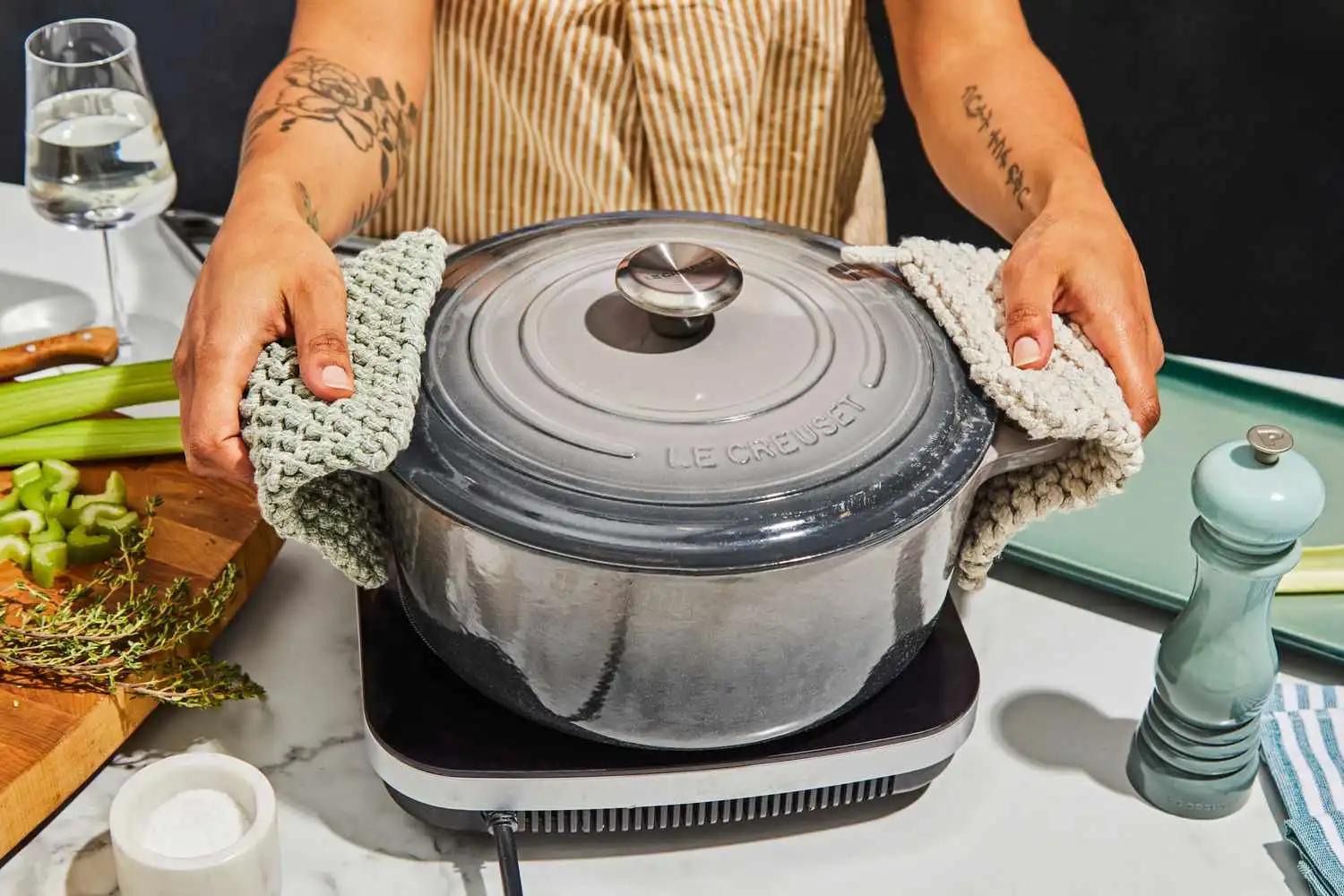
The Dutch oven vs slow cooker question isn’t really about which one is better. It’s about what you’re trying to do. They produce different results from the same ingredients, and knowing where each one genuinely wins helps you make the call before you start.
| Feature | Slow Cooker / Crock-Pot | Dutch Oven |
|---|---|---|
| Heat source | Electric element, base only | Convective oven heat, all sides |
| Moisture | Sealed; zero evaporation | Some evaporation; liquid reduces |
| Flavor | Gentle, blended, mild | Deep, browned, concentrated |
| Browning | Not possible in-pot | Stovetop sear in same vessel |
| Sauce texture | Thin; requires separate reduction | Naturally thickens during cook |
| Effort level | Set and walk away | Needs occasional check |
| Best for | Workday, unattended cooking | Weekend meals, flavor-forward dishes |
The Dutch oven wins on flavor. Full stop. The Maillard reaction — the browning that happens when protein surface temperatures exceed 300°F in a dry environment — is physically impossible inside a slow cooker. The cooker’s liquid-capped environment never gets hot enough for proper searing. In a Dutch oven, you sear the meat directly on the stovetop, build the fond (the caramelized brown bits at the bottom), deglaze, and carry all that flavor into the braise. That step adds a depth that slow cooker recipes can’t match regardless of how good the seasoning is.
But the crock pot vs Dutch oven debate isn’t one-sided. The slow cooker wins for convenience. It genuinely is set-it-and-forget-it — no heat-check needed, no risk of the liquid reducing too fast. For busy weekdays when you want to start dinner before work and come home to something ready, the slow cooker remains the practical choice. Some cooks use both strategically: slow cooker during the week, Dutch oven on weekends when there’s time to invest in a better result. That’s a reasonable approach, and this conversion knowledge means the same recipes work on either tool.
How to Convert Any Slow Cooker Recipe to a Dutch Oven
The process follows the same sequence regardless of the specific recipe. Here’s how to convert slow cooker to Dutch oven dishes step by step:
- Brown your protein first. Pat the meat dry — moisture is the enemy of a proper sear. Heat the Dutch oven on the stovetop over medium-high heat, add a thin film of oil, and sear until you get a proper mahogany crust on all sides. This takes 8 to 12 minutes for most cuts and it’s worth every minute. This is the step that separates a Dutch oven braise from a slow cooker dish.
- Deglaze the pot. Add wine, broth, or another cooking liquid and scrape up the fond with a wooden spoon. That brown crust on the bottom is concentrated flavor — deglazing captures it all and folds it into the sauce.
- Reduce the liquid. Use the table above as your guide. For a traditional braise, reduce the original slow cooker recipe’s liquid by 20 to 33 percent. You want it to come halfway up the sides of the meat, not cover it.
- Cover and place in a 325°F oven. Keep the lid on. Check the liquid level once during the cook — if it’s dropping too fast and approaching the bottom of the pot, add a splash of warm stock.
- Check early. Start checking at the low end of the converted time window. For an 8-hour slow cooker recipe, that means checking at 2 hours in the Dutch oven. Once the meat pulls apart easily, it’s done.
If you’re doing the oven to slow cooker conversion in reverse — taking a Dutch oven recipe and moving it to a slow cooker — the same logic applies backward. Increase liquid by 20 to 30 percent, multiply the Dutch oven time by roughly three for Low or two for High, and skip the searing step (or do it in a separate pan first if you want the flavor).
The way I look at it after years of testing both methods: the Dutch oven isn’t just a substitute. For weekend cooking where you have time to be present, it actively produces a better dish. The slow cooker wins on convenience, not quality. Knowing how to convert between them means you’re never locked into one approach. For more on food science and kitchen technique, explore the Osito food technology resource for deeper dives on both.
What temperature is a slow cooker on low?
The Low setting on a slow cooker typically reaches an operational temperature of 170°F to 200°F (77°C to 93°C) at the liquid level, according to USDA guidelines. The crockpot temperature on low is designed to keep liquid at a very gentle simmer — well below a rolling boil — over 6 to 10 hours. Clemson University Extension notes that a properly functioning slow cooker on Low should reach approximately 185°F after 8 hours of cooking; any cooker that can’t reach this threshold isn’t heating safely or consistently. Older models and certain brands run hotter than this range, which is why experienced slow cooker users often find recipes finishing ahead of schedule. If you’re trying to replicate this in a Dutch oven, 325°F in a conventional oven reliably produces the same internal simmer environment in a fraction of the time.
Is a Dutch oven the same as a Crock-Pot?
No — a Dutch oven and a Crock-Pot are two different tools, though they can produce similar results for braise-style recipes. A Crock-Pot is a brand name that became a generic term for slow cookers: electric countertop appliances with a ceramic insert and a heating element in the base. A Dutch oven is a heavy-walled pot, typically enameled cast iron, that works on the stovetop and inside a conventional oven. So when comparing dutch oven vs crock pot, the main differences are versatility and flavor development: a Dutch oven can sear, saute, braise, bake bread, and reduce sauces all in one vessel; a Crock-Pot is specialized for low, slow, unattended cooking. They aren’t interchangeable by design, but they are interchangeable by outcome for most braise recipes — which is exactly what this conversion chart addresses.
How do I use a Dutch oven as a slow cooker?
You can use a Dutch oven as a slow cooker in two ways: in the oven at 300°F to 325°F, or on the stovetop over the lowest possible heat setting. The oven method is more reliable — set it to 325°F, cover the pot, and follow the converted time from the chart above. For stovetop use, keep the heat at the absolute minimum to maintain a bare simmer; a heat diffuser under the pot helps on gas stoves where low settings can still run hot. Check the liquid level every 30 to 45 minutes when using the stovetop method, since the heat is harder to control precisely than in an oven. Both methods work, but if you’re asking whether you can use a Dutch oven instead of a slow cooker for an all-day cook while you’re out — the oven version can handle 2 to 4 hours unattended, but it’s not a true set-and-leave situation the way a slow cooker is.
How do I convert a Dutch oven recipe back to a slow cooker?
The Dutch oven to slow cooker conversion is the same math in reverse. Multiply the Dutch oven cook time by roughly three for the Low setting, or two for High — so a Dutch oven braise that takes 2.5 hours at 325°F becomes 7 to 8 hours on Low or 4 to 5 hours on High in a slow cooker. For the oven to slow cooker conversion on liquid, increase the total amount by 20 to 30 percent, since the slow cooker traps all moisture and the dish needs enough liquid to conduct heat through the crock. If the Dutch oven recipe starts with a stovetop sear (and most good ones do), you can replicate this in a separate skillet before transferring to the slow cooker — it’s an extra pan to wash, but the fond it creates is worth it. Skip that step entirely and the finished dish will taste noticeably flatter, especially if the original Dutch oven recipe was specifically built around browning and reduction.
The Bottom Line on Slow Cooker to Dutch Oven Conversion
The conversion comes down to three adjustments: time, temperature, and liquid. Cut the slow cooker time to about 30 to 40 percent of the original. Set the oven to 325°F. Reduce liquid for braises, add liquid for soups. Everything else — seasoning, vegetables, aromatics — transfers with no changes at all.
Understanding the physics behind the conversion is what makes it reliable. The Dutch oven works faster because convective oven heat surrounds the pot from all sides, while the slow cooker heats from the base alone. That’s not a subtle difference — it’s the entire reason the timing changes so dramatically. And the Dutch oven’s ability to go from stovetop to oven means you get something the slow cooker can never offer: a proper sear, real fond, and a sauce that reduces naturally without a separate pot.
The slow cooker still wins where it matters most for busy schedules — true unattended cooking for 8 to 10 hours is something a Dutch oven in the oven can’t fully replicate. But for weekend cooking, flavor-forward dishes, and any recipe where you want depth in the final sauce, the Dutch oven is the stronger tool. Now you know how to use both interchangeably, and that’s a genuinely useful thing to have in your back pocket.
Sources
- USDA Food Safety and Inspection Service. “Slow Cookers and Food Safety.” USDA FSIS, 2023.
- University of Minnesota Extension. “Slow Cookers and Food Safety.” UMN Extension, 2024.
- Clemson University Cooperative Extension. “Slow Cooker Food Safety.” HGIC, 2025.
- Science of Cooking. “Science of Slow Cooking.” ScienceofCooking.com.
- ET-Chem. “What Temperature Does Collagen Break Down? Cooking Science.” ET-Chem, 2024.
- Sauté Cookware. “The Science Behind Cooking with Cast Iron Dutch Ovens.” Sauté, 2026.

Bella covers everything from smart appliances and food gadgets to cooking techniques and kitchen science, always with a focus on practical advice that works in real home kitchens. She’s tested dozens of countertop appliances across every category — from air fryers and electric kettles to smart coffee makers and induction cooktops — with a focus on what actually holds up under daily use rather than what looks good in a spec sheet. When she’s not testing the latest gear or debating induction versus gas, she’s probably trying a new recipe that calls for way too many fresh herbs.
Other blogs
Fridge Freezing Food? Here’s Why and How to Fix It
A fridge freezing food is almost always fixable — and rarely means a major repair. This guide covers every common…
Read More →Air Fryer vs Convection Oven: Are They the Same Thing?
Here’s the question that quietly drives a lot of kitchen appliance confusion: is an air fryer just a convection oven?…
Read More →Induction vs Gas: The Truth Most Guides Won’t Tell You
The induction vs gas debate has become strangely tribal. Gas devotees talk about flame control and the feel of real…
Read More →Smart Coffee Maker: Is WiFi in Your Brewer Worth It?
The promise of a smart coffee maker is straightforward: coffee ready the moment you wake up, brew started from your…
Read More →