

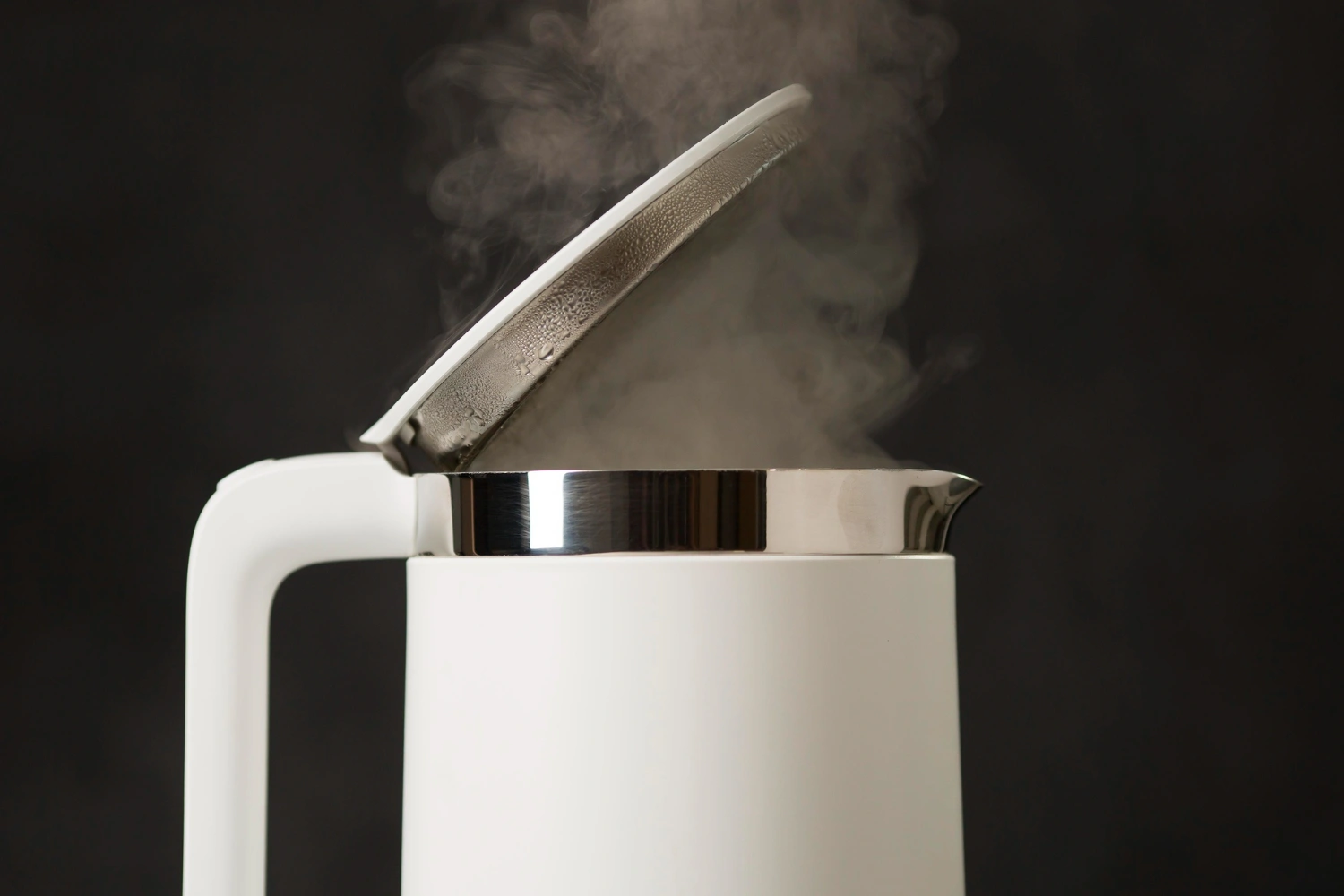
I test kitchen tech for a living, and the electric kettle is the appliance I get asked about more than almost anything else. It seems simple. It’s not. The difference between a good one and a frustrating one comes down to a few specific design choices — what the interior is made of, how precisely temperature is controlled, and whether the spout actually matches how you brew. This guide covers all of it.
I’ve been through more kettles than I care to admit. The cheap plastic one that made my tea taste faintly chemical. The glass one I cracked against the faucet at 7am. The fancy gooseneck I bought for pour-over and then resented every time I needed to fill a pot quickly. Each one taught me something. And what I’ve landed on is this: the right electric tea kettle isn’t the most expensive one, and it’s rarely the one with the most features. It’s the one that matches how you actually use your kitchen every morning.
Whether you’re looking for a precise electric tea pot for green and oolong teas, a fast general-purpose boiler, a smart connected kettle, or the best electric gooseneck kettle for pour-over coffee — this guide has a clear answer for each situation.
In This Article
- Why Bother With a Hot Water Kettle Electric?
- Why the Material Inside Your Kettle Matters Most
- Do You Actually Need Variable Temperature?
- Do You Need an Electric Gooseneck Kettle?
- Which Electric Tea Kettle Is Actually Best?
- The Zwilling Recall: What Buyers Need to Know
- Best Budget Electric Tea Kettles
- Frequently Asked Questions
- What to Buy and When to Spend More
- Reviews: 5 Top Electric Kettles Tested
Why Bother With a Hot Water Kettle Electric?
The honest answer: speed and precision. A dedicated hot water kettle electric brings a full liter to a boil in roughly three to four minutes. A standard gas burner with a stovetop pot takes about double that. And it does it without tying up a burner, without you standing over it, and without the slightly alarming whistle at the end.
There’s a real efficiency argument too. According to the U.S. Department of Energy, appliances that transfer heat directly to their load — which is exactly what an electric kettle does — waste far less energy than those that heat indirectly through a flame or coil. I’ve started using my kettle to jump-start pasta water on busy weeknights because it genuinely makes a difference in total cook time.
Beyond the obvious uses for tea and coffee, kettles earn their counter space in ways that sneak up on you:
- Boiling a full kettle and pouring it directly into a pasta pot — cuts time and frees the burner for the sauce
- Rehydrating dried mushrooms, rice noodles, or couscous instantly rather than waiting on the stove
- Blanching small quantities of vegetables without dragging out a full pot
- Instant oatmeal, miso, ramen — faster and less mess than the microwave
If you’re building out a more connected kitchen and wondering how a smart kettle fits into the bigger picture, our smart kitchen appliances guide covers how these tools work together day-to-day.
Why the Material Inside Your Kettle Matters Most
Here’s the part most buying guides skip entirely: the brand name on the outside of your kettle matters far less than the material touching your water on the inside. I learned this the hard way with a mid-range kettle that started producing water with a faint plasticky odor about eighteen months in. By month two I’d noticed the water window seal starting to pull. By month eighteen the electronics had shorted. Classic failure mode.
The safest and most durable interior is food-grade 304 stainless steel, ideally in a seamless unibody design with no internal welds, joints, or gaskets. No seams means no failure points where mineral water can work its way through over time. Borosilicate glass is the other strong option: chemically neutral, adds zero taste to the water, and gives you a clear view of water level without ever touching plastic. It’s more fragile than steel, but handled with any care it lasts.
The problem is the plastic water window — that little transparent strip cut into the side of most mid-range stainless kettles. It looks convenient. And it is, until it isn’t. Here’s the engineering reality: sealing a polymer piece against stainless steel requires those two materials to expand and contract in sync under heat. They don’t. Stainless and plastic have different thermal expansion coefficients. After hundreds of heating cycles over a few years, that seal degrades. It cracks, softens, separates — and water finds its way into the base. Wirecutter sent kettles to a metallurgy team at Ohio State University and found that nearly all mid-range models share the same internal circuit board. The electronics aren’t the differentiator. The materials are.
“Pricier kettles don’t necessarily have more-durable electronics. You’re paying for looks, construction, and fancier features.”
Wirecutter / New York Times, Electric Kettle Long-Term Testing, Ohio State University metallurgy assessment
My practical rule: if a kettle has a plastic water window, I factor in a 3 to 4-year lifespan under heavy use. If it doesn’t, I expect it to last considerably longer. For everyday longevity, the Ninja KT200’s fully stainless interior earns its recommendation. For complete plastic-free purity, the OXO Brew glass kettle is the answer.
Do You Actually Need Variable Temperature?
Only if you’re brewing something that cares. Which, depending on what’s in your cup, might be more often than you think.
The reason temperature matters for tea comes down to chemistry. Green tea leaves are minimally oxidized and loaded with catechins — delicate compounds that turn bitter and astringent fast when they hit boiling water. White tea is even more sensitive. Oolong sits in the middle of the spectrum. Black tea, being fully oxidized, handles near-boiling water without much consequence. The temperature guidelines from Breville and every major tea authority align on this. It’s not subjective. Brew green tea at 212°F and it tastes worse. Every time.
For coffee, the National Coffee Association recommends 195 to 205°F for optimal extraction. Boiling water at 212°F over-extracts, pulling bitter compounds before the desirable sugars and acids have their moment. A variable temperature kettle lets you hit that window consistently.
| Beverage | Temp (°F) | Temp (°C) | Steep / Brew Time |
|---|---|---|---|
| White tea | 150–170°F | 65–77°C | 2–5 min |
| Green tea | 160–185°F | 71–85°C | 1–3 min |
| Oolong tea | 185–205°F | 85–96°C | 3–5 min |
| Black tea | 200–212°F | 93–100°C | 3–5 min |
| Herbal / tisane | 212°F | 100°C | 5–7 min |
| Pour-over coffee | 195–205°F | 91–96°C | Per recipe |
| French press | 195–200°F | 91–93°C | 4 min |
If you only ever boil water for black tea, cooking, or instant drinks — skip the variable temperature feature entirely. Save the $30 and put it toward a better interior material. But if your mornings involve rotating between a green tea, a pour-over, and occasionally a white tea on weekends? Variable temperature will change the quality of every single cup. Keep-warm functions, which hold your set temperature for 20 to 60 minutes, are genuinely worth having once you’re in variable temp territory — getting distracted mid-morning and coming back to still-hot water is a small luxury that adds up.
Do You Need an Electric Gooseneck Kettle?
If you brew pour-over coffee regularly: yes, and nothing else will do the job as well. If you don’t: a gooseneck will frustrate you within a week.
I say that having owned both. The gooseneck’s long, curved, narrow spout restricts water flow to a slow, controlled stream that you can direct precisely — essential for the bloom and spiral pour that pour-over requires. The Fellow Stagg EKG, which I’ve used for about two years, limits pour rate to a range of 1.5 to 25 grams per second. That kind of control is what separates an evenly extracted, clean pour-over from a channeled, sour one. No standard wide-spout kettle can replicate it, regardless of how carefully you pour.
But that same narrow spout becomes genuinely annoying when you just need to fill a French press for three people, pour a pint of water into a pot, or do anything that requires moving volume quickly. Gooseneck kettles also tend to cap out around 0.9 liters, so frequent refills come with the territory. A quick checklist:
- You brew pour-over at least a few times a week: get a gooseneck, it will improve your results noticeably
- You steep delicate loose-leaf teas and want directional precision: probably worth it
- You want one kettle that handles everything: standard wide-spout kettle, no question
- You mainly make black tea or use the kettle for cooking: gooseneck is wrong tool entirely
Some households keep both. I do. The Fellow lives next to the pour-over setup; a standard 1.7L kettle handles everything else. That’s not necessary for most people, but if both use cases genuinely apply to you, it’s worth considering rather than trying to compromise with one device.
Which Electric Tea Kettle Is Actually Best?
There isn’t one best electric kettle. There’s one that’s best for how you actually cook. After going through the full spec data across nine current models, here’s how the top contenders map to different households.
The Ninja KT200 is my default recommendation for most people. It boils 1.7 liters in 4 minutes and 10 seconds, offers genuine degree-by-degree control from 140 to 212°F, runs at a relatively quiet 62 decibels, and uses a fully stainless steel interior with no plastic water window. At around $89 it’s the most honest value in the category. The one-year warranty is the weak point — shorter than I’d like — but in day-to-day use it performs better than models costing $40 more.
The OXO Brew Adjustable Temperature Glass Kettle is the pick for anyone who wants zero polymer contact with their water. The borosilicate glass body is completely neutral, the rotary dial gives 1°F increments from 104 to 212°F, and the slow-open lid is genuinely thoughtful design. The catch is boil time: 7 minutes and 28 seconds for a full 1.75 liters is noticeably slower than anything else at this price. For small volumes, that gap closes fast. But if you’re regularly boiling a full kettle, factor it into your morning math.
The Fellow Stagg EKG is for pour-over coffee. Full stop. Its PID controller prevents temperature overshoot rather than simply cutting power at a target, which means it stays exactly at your set temperature rather than spiking past it. At $165 it’s expensive and its 0.9-liter capacity limits general use. But for its specific purpose, it’s the best tool available.
| Model | Capacity | Wattage | Temp Control | Boil Time | Warranty | Price | Best For |
|---|---|---|---|---|---|---|---|
| Ninja KT200 | 1.7L | 1500W | Degree-by-degree | 4:10 | 1 yr | ~$89 | Best all-around |
| Cuisinart CPK-17 | 1.7L | 1500W | 6 presets | ~5:00 | 3 yrs | ~$100 | Longest warranty |
| OXO Brew Glass | 1.75L | 1500W | Rotary dial 1°F | 7:28 | 2 yrs | ~$120 | Plastic-free water path |
| Fellow Stagg EKG | 0.9L | 1200W | PID, degree-by-degree | 5:00–5:30 | 2 yrs | ~$165 | Pour-over coffee |
| GoveeLife Smart Pro | 1.7L | 1500W | App + voice | ~5:00 | 1 yr | ~$75 | Smart home |
| Zwilling Enfinigy 1.0L | 1.0L | 1500W | 6 presets | ~3:30 | 5 yrs | ~$129 | Safety / families |
| Cosori CO108-NK | 0.8L | 1200W | 5 presets | 4:17 | 2 yrs | ~$70 | Budget gooseneck |
A word on the Cuisinart CPK-17 — Wirecutter’s top pick since 2013. It’s a solid, well-tested kettle, and the three-year warranty is genuinely the best in its price class. But the TPX plastic water window is a real engineering vulnerability. The differential expansion between steel and polymer over years of heating cycles eventually compromises that seal. For short-term buyers it probably doesn’t matter. For anyone planning heavy daily use over five-plus years, the Ninja’s all-steel interior is the smarter long-term choice.
If smart home integration matters to you, the GoveeLife Smart Electric Kettle Pro stands out. WiFi and Bluetooth, Alexa and Google Assistant support, a removable stainless steel tea infuser, and up to two hours of app-controlled keep-warm. For the right household, it’s the most capable connected kettle under $100. For more on how connected appliances fit into an AI-assisted kitchen, our guide to AI in your kitchen is a useful next read.
The Zwilling Recall: What Buyers Need to Know
On May 14, 2026, Zwilling issued a voluntary recall of approximately 113,440 units of its 1.5-liter Enfinigy Electric Kettle and Enfinigy Pro Electric Kettle. The recall is listed on the U.S. Consumer Product Safety Commission website. The issue: the handle can loosen or break off, spilling hot water. Affected owners should stop using the recalled units immediately and follow Zwilling’s refund process.
The nuance that’s getting lost in coverage: only the 1.5-liter models are recalled. The 1.0-liter Enfinigy Compact Pro uses a completely different reinforced unibody construction and is not affected. That smaller model is still a strong buy — double-wall cool-touch exterior, seamless stainless interior with no plastic window, five-year warranty. It’s the best warranty in the consumer kettle category by a significant margin.
But there’s a catch. The 1.0-liter capacity yields about four cups per fill. For a single person or couple that’s fine. For anyone regularly making a full pot of tea for more people, or doing any volume boiling for cooking, you’ll be refilling constantly. Weigh that against the safety and longevity advantages before deciding.
Best Budget Electric Tea Kettles
Not every household needs precision temperature control or a premium interior. If you’re mostly boiling water for black tea, cooking, or instant drinks, a well-built budget model does the job without compromise on what actually matters: stainless steel interior, automatic shut-off, and boil-dry protection. Those three features are non-negotiable at any price point.
The Hamilton Beach 40880 is the reliable workhorse of the budget category. Stainless interior, boils a liter in around four minutes, costs under $40. No variable temperature, no keep-warm. But it’s fast, clean, and doesn’t try to be more than it is. The plastic lid hinges are the only real durability concern — metal hinges on pricier models hold up better over time.
In the budget gooseneck category, the Cosori Electric Gooseneck Kettle (CO108-NK) is the standout. It heats 0.8 liters in just over four minutes at 1,200 watts, includes five temperature presets, holds temperature for 60 minutes, and costs around $70. For anyone who wants to get into pour-over without spending Fellow money, this is the entry point I’d recommend. The fill line visibility is poor in low light and the capacity is small, but neither is a reason to pass on it. The Chefman electric kettle line is also worth a look at this price range, particularly the glass models with color-temperature indicators — though in my experience Cosori’s build consistency is more reliable over time.
Water quality is worth mentioning here too. Hard tap water deposits mineral scale on the heating element, which reduces efficiency and shortens the lifespan of any kettle — budget or premium. Descaling every two to three months with a 50/50 white vinegar and water solution keeps things clean. Our guide to making distilled water at home covers mineral management if you’re in a hard water area.
What is the best electric tea kettle for most households?
In my view, the Ninja KT200 Precision Temperature Kettle is the best all-around choice for most home kitchens in 2025. It boils 1.7 liters in about four minutes and ten seconds, offers degree-by-degree control from 140 to 212°F, and uses a fully stainless steel interior with no plastic water window. At around $89, it delivers more precision than most competitors at the same or higher price. The one weakness is a one-year warranty, shorter than the Cuisinart CPK-17’s three-year coverage. If warranty peace of mind matters more to you than temperature precision, the Cuisinart is a defensible choice. For pour-over coffee specifically, nothing comes close to the Fellow Stagg EKG — it’s expensive and specialized, but it genuinely earns its premium for the right buyer.
How often should I descale my electric kettle?
In areas with moderately hard tap water, descaling every one to two months keeps things running well. In hard water regions, monthly is more appropriate. The tell-tale sign is white chalky buildup on the heating element or interior walls — if you see it, it’s already overdue. The method I use: fill the kettle with equal parts white vinegar and water, bring it to a boil, let it sit for an hour, pour it out, and rinse twice with fresh water. Some manufacturers sell proprietary descaling solutions, but plain white vinegar works equally well at a fraction of the cost. Staying on top of descaling extends the heating element’s life meaningfully — it’s the single most impactful maintenance habit for any kettle.
Is an electric kettle actually more efficient than the stovetop?
Yes, consistently. An electric kettle applies heat directly through an internal element; almost all of that energy goes into heating the water. A stovetop burner, gas or electric, loses a significant portion of its energy heating the surrounding pot surface, the air around it, and in the case of gas, the open flame environment. In real-use comparisons, electric kettles boil the same volume of water in roughly half the time and with less wasted energy. The exception is high-wattage induction burners, which operate on a similar direct-transfer principle and can rival kettle speed. But for a standard home kitchen setup, an electric kettle is the most efficient and fastest way to boil water, full stop.
Can I use a regular kettle for pour-over coffee?
Technically yes, but the results will be noticeably worse than with a gooseneck. Pour-over requires a slow, controlled, directional pour to saturate the coffee grounds evenly — a wide-spout kettle releases too much water too quickly, making channeling (uneven extraction) nearly impossible to avoid. You can partially compensate by pouring from a lower height and going very slowly, but you’re fighting the tool rather than using it. If you’re making pour-over more than occasionally, the Cosori CO108-NK at around $70 is the lowest-cost entry into proper gooseneck control. It’s a significant improvement over improvising with a standard spout, especially if you’re already investing in quality beans and a good brewer.
What to Buy and When to Spend More
Most households land well in the $70 to $100 range. That covers the Ninja KT200, the Cosori gooseneck, and the upper end of the budget stainless options. Variable temperature, keep-warm, fast boiling, stainless interior without a plastic water window. That’s genuinely everything most home cooks and tea drinkers need — not a compromise version of it.
Spending more makes sense in two clear cases. First, dedicated pour-over coffee brewing: the Fellow Stagg EKG at $165 delivers PID temperature accuracy and gooseneck flow control that actually show up in the cup. Second, households prioritizing safety and longevity: the Zwilling Enfinigy Compact Pro 1.0L (unaffected by the recall) has a five-year warranty, seamless unibody stainless, and a cool-touch exterior. For families with young children, that cool-touch design changes the calculus meaningfully.
The kettles that get used daily are the ones that match how you actually cook, not the ones with the best spec sheets. I’ve seen beautiful $200 goosenecks sit at the back of counters because their owners mostly needed fast pasta water. I’ve also seen a $45 Hamilton Beach run flawlessly for years in a kitchen that didn’t need more than a fast boil. Know what you’re making, match the tool to the task, and you’ll get it right. If you’re building out the full precision kitchen setup, our home espresso machine guide and ChatGPT meal planning guide are natural next reads. For the connected kitchen angle, our robot vacuum kitchen guide covers smart home tools that keep the whole space running smoothly.
Reviews: 5 Top Electric Kettles Tested
These five kettles represent the clearest choices across the range of real buyer needs: best all-around, best pour-over tool, best for plastic-averse households, best warranty, and best smart home integration. Each review draws on the full specification data from independent testing, with my own notes on what those specs actually mean in daily kitchen use.
Ninja Precision Temperature Kettle KT200
Best All-Around
~$89 · 1500W · 1.7L · 1-year warranty
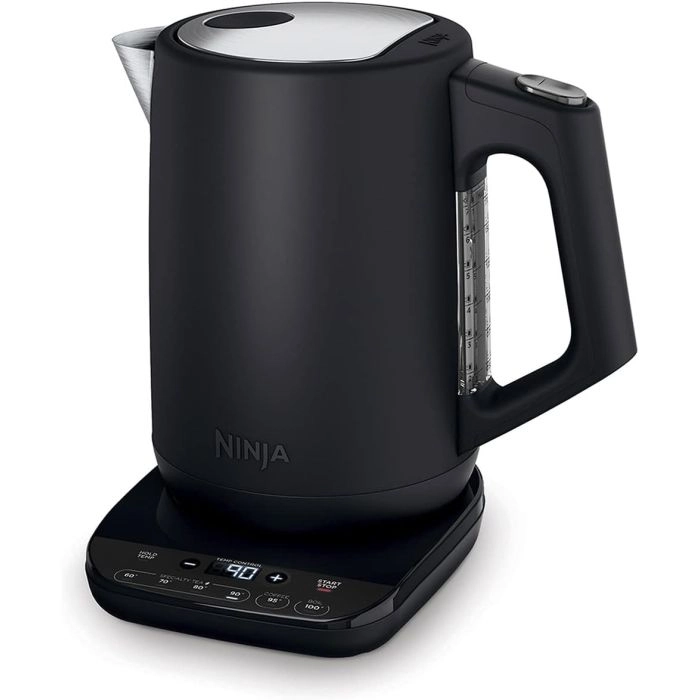
| Capacity | 1.7 liters (60 oz / ~7 cups) |
|---|---|
| Wattage | 1,500W |
| Interior material | 100% BPA-free stainless steel — no plastic water window |
| Temperature control | 6 presets + manual degree-by-degree (140°F–212°F) |
| Boil time (full) | 4 minutes 10 seconds |
| Keep-warm | 30 minutes (auto after reaching target) |
| Noise level | 62 dB at peak rolling boil |
| Warranty | 1 year limited |
| Price range | $80–$100 |
Pros
- Degree-by-degree control from 140°F to 212°F — most precise in its price class
- Fastest full boil of any 1.7L kettle tested: 4 min 10 sec
- Fully stainless steel interior — no plastic water window, better long-term durability
- Quieter than comparable models at 62 dB
- Auto keep-warm activates without a second button press
Cons
- Only a 1-year warranty — shortest among the top-tier picks
- Brushed steel exterior shows fingerprints and smudges easily
- Thermistor can develop minor calibration drift after extended years of heavy use
- No smart home connectivity or app control
This is the kettle I’d recommend to most people without hesitation. The combination of genuine degree-by-degree control and a fully stainless interior at under $90 is hard to beat. The one-year warranty is the weak link in an otherwise strong package — but if you’re not running it ten times a day for years, it’s unlikely to be an issue. For tea drinkers who rotate between green, oolong, and black teas, the ability to set 175°F one morning and 205°F the next without hunting through preset menus makes this the most practical precision kettle at this price. It’s the one sitting on my counter right now.
Fellow Stagg EKG Electric Gooseneck Kettle
Best for Pour-Over Coffee
~$165 · 1200W · 0.9L · 2-year warranty
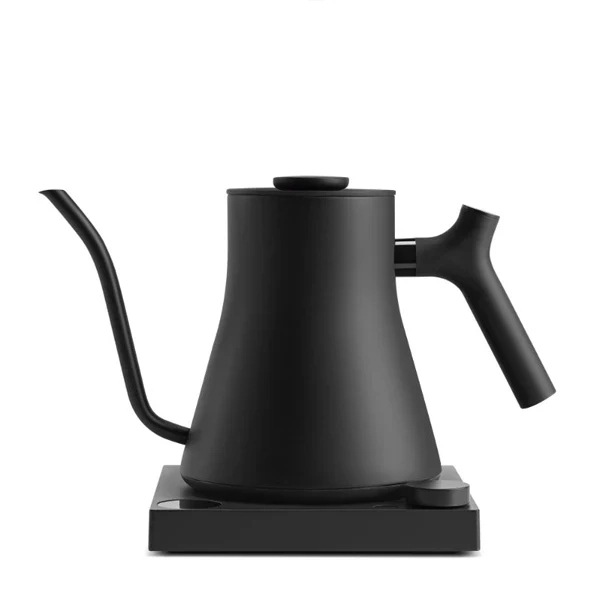
| Capacity | 0.9 liters (30 oz) |
|---|---|
| Wattage | 1,200W |
| Interior material | 304 stainless steel; matte powder-coated exterior |
| Temperature control | PID controller, degree-by-degree (135°F–212°F) |
| Boil time (full) | 5 min – 5 min 30 sec |
| Keep-warm | 60 minutes (toggle-activated) |
| Pour rate | 1.5–25 grams per second (gooseneck precision flow) |
| Noise level | 67 dB at start, dropping to 51 dB at boil |
| Warranty | 2 years limited (US and Canada) |
| Price range | $165–$200 |
Pros
- PID controller prevents temperature overshoot — the most precise temp accuracy available
- Gooseneck pour rate (1.5–25 g/sec) enables consistent bloom and spiral pour for pour-over
- Counterbalanced handle reduces wrist fatigue during slow, extended pours
- 60-minute keep-warm — double the standard 30-minute hold
- Consistently beautiful on the counter — design matters for a daily-use appliance
Cons
- 0.9L capacity means frequent refills for multi-cup or multi-person use
- Restricted gooseneck spout is genuinely impractical for general kitchen tasks
- Premium price — one of the most expensive options in the category
- Electronic base is sensitive to prolonged moisture and steam exposure
- Not suited to casual or all-purpose boiling households
I’ve used the Fellow Stagg EKG for about two years and have no plans to replace it for pour-over. The PID temperature control is meaningfully different from a standard thermostat — it doesn’t spike past your target and cut power, it approaches the temperature and stays there. Combined with the gooseneck’s flow control, you have everything needed to dial in a recipe and reproduce it faithfully. That said, I’m honest with people about this: it’s a specialist tool. At $165, the specialization has to earn its price. For pour-over coffee drinkers, it does. For everyone else, it’s money spent on precision you won’t use.
OXO Brew Adjustable Temperature Glass Kettle
Best Plastic-Free
~$120 · 1500W · 1.75L · 2-year warranty
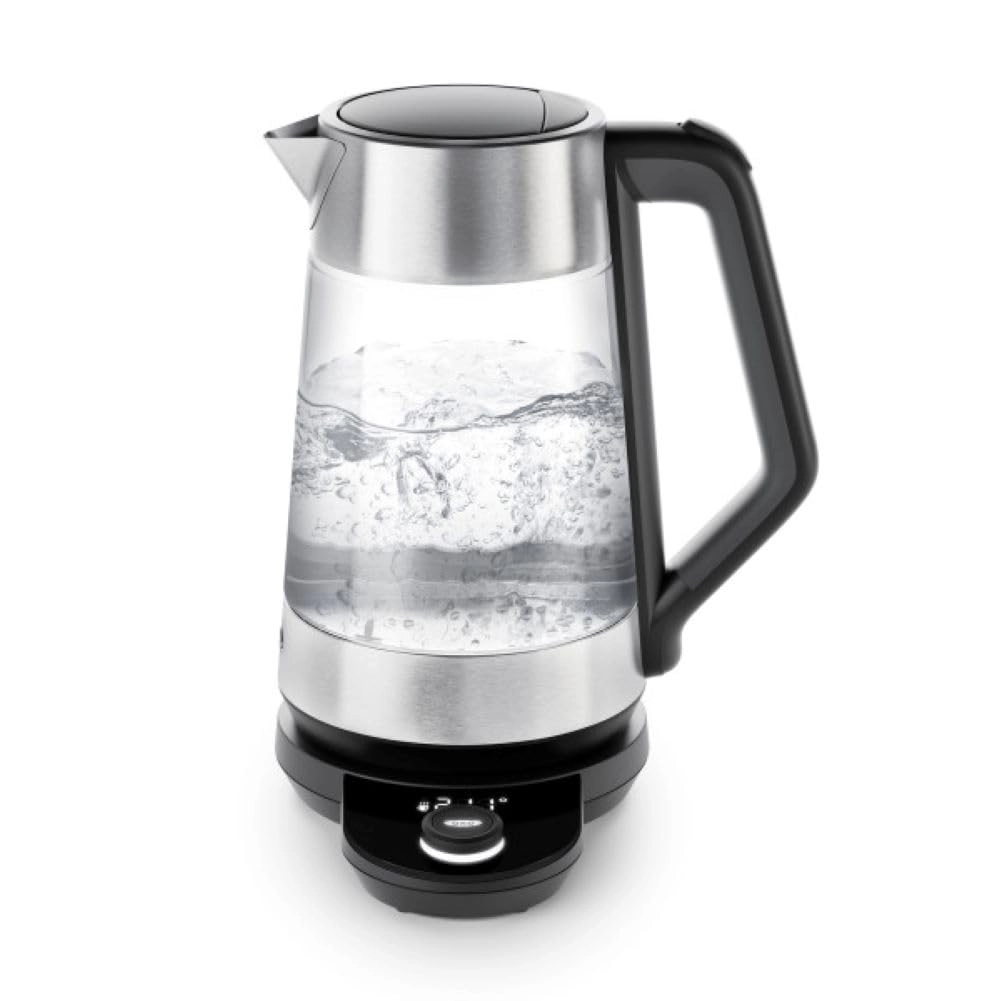
| Capacity | 1.75 liters (60 oz) |
|---|---|
| Wattage | 1,500W |
| Interior material | Borosilicate glass; stainless steel heating floor, filter, and spout; silicone cool-touch base |
| Temperature control | Continuous rotary dial (104°F–212°F in 1°F increments) |
| Boil time (full) | 7 minutes 28 seconds |
| Keep-warm | 30 minutes (auto-activates on every cycle) |
| Warranty | 2 years limited |
| Price range | $100–$120 |
Pros
- Borosilicate glass means zero polymer contact with your water — as clean as it gets
- Rotary dial gives 1°F increment control — the most granular setting of any kettle tested
- Slow-open lid disperses steam gradually, preventing accidental burns on opening
- Visual feedback — water level and boiling action visible at a glance, no lid opening needed
- 2-year warranty from a brand with a strong customer service track record
Cons
- Slowest boil of the group at 7:28 for full 1.75L — noticeably behind the competition
- Glass body is fragile — one knock against a hard surface can end it
- Keep-warm engages automatically on every cycle; no option to disable it
- Large footprint — can’t operate under low cabinets due to steam clearance requirements
The OXO glass kettle makes one promise and keeps it completely: the water never touches plastic. For anyone who has noticed an off-taste from cheaper kettles — and once you taste it, you can’t un-taste it — this is the fix. The rotary dial is a pleasure to use, more intuitive than any button preset system. The boil time is the real trade-off. Nearly seven and a half minutes for a full kettle is legitimately slower than the Ninja or Cuisinart. For smaller volumes the gap closes, but it’s real. If speed is secondary and material purity is primary, this is my recommendation without reservation. Handle it with a little care and it’ll last years.
Cuisinart CPK-17 PerfecTemp Cordless Electric Kettle
Best Warranty
~$100 · 1500W · 1.7L · 3-year warranty
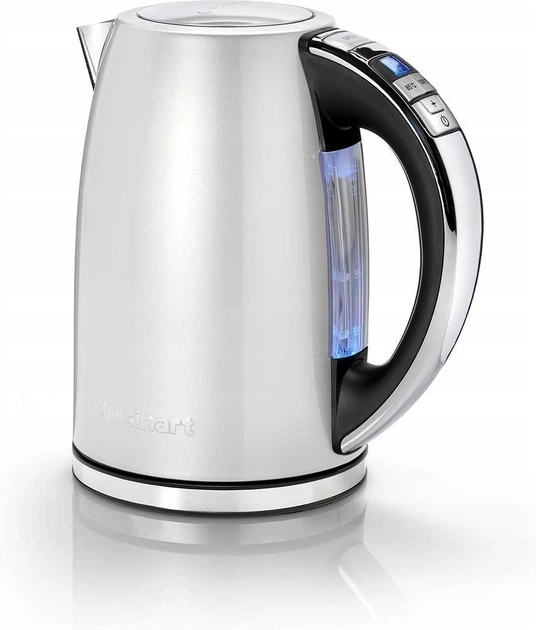
| Capacity | 1.7 liters (57 oz / ~7 cups) |
|---|---|
| Wattage | 1,500W |
| Interior material | Brushed stainless steel; TPX (polymethylpentene) water-level window |
| Temperature control | 6 tactile presets on handle (160°F / 175°F / 185°F / 190°F / 200°F / 212°F) |
| Boil time (full) | ~5 minutes |
| Keep-warm | 30 minutes (auto; 2-minute memory off base) |
| Warranty | 3 years limited — longest in its price class |
| Price range | $90–$130 |
Pros
- 3-year warranty is the best coverage of any standard consumer kettle at this price
- Handle-mounted preset buttons — ergonomic and well away from steam
- 2-minute base memory: resumes keep-warm cycle automatically when returned within 120 sec
- Audible beep when target temp is reached — useful when you step away mid-morning
- Over a decade of proven reliability data across millions of units
Cons
- TPX plastic water window is a structural vulnerability — seal degrades over years of thermal cycling
- Fixed to 6 preset temperatures — no degree-by-degree control
- Runs 2–3°F high at the 160°F setting — noticeable for delicate white teas
- Button labels can wear off with certain cleaning products over time
- Base contact terminals can oxidize, causing premature low-water beeping
The Cuisinart CPK-17 has been the go-to recommendation since 2013, and it deserves that reputation — for a point. It’s reliable, the handle-mounted buttons are genuinely clever ergonomics, and the three-year warranty is the strongest peace-of-mind argument in the category. But I won’t pretend the plastic water window isn’t a concern. The seal between polymer and steel is a structural weak point that thermal cycling will eventually compromise. For a buyer who plans heavy daily use for five or more years, the Ninja KT200’s all-steel interior is the smarter long-term purchase. For someone who wants proven reliability and values warranty coverage above all else, the Cuisinart still earns its place.
GoveeLife Smart Electric Kettle Pro (H717A)
Best Smart Kettle
~$75 · 1500W · 1.7L · 1-year warranty
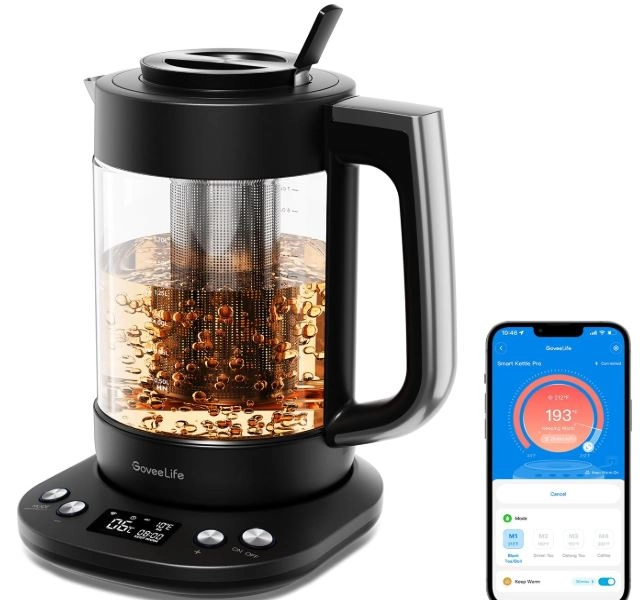
| Capacity | 1.7 liters (57 oz) |
|---|---|
| Wattage | 1,500W |
| Interior material | Stainless steel with removable stainless mesh tea infuser |
| Temperature control | App, voice, and 4 physical base buttons; custom preset support |
| Connectivity | 2.4 GHz WiFi + Bluetooth dual-band |
| Smart home | Amazon Alexa, Google Assistant, Google Home, GoveeLife app |
| Keep-warm | Up to 2 hours (app-adjustable) |
| Temperature accuracy | ±2°F of target |
| Warranty | 1 year limited |
| Price range | $64–$80 |
Pros
- Full WiFi + Bluetooth — works with Alexa and Google Assistant out of the box
- App-controlled scheduling and custom holds up to 2 hours
- Removable stainless steel tea infuser built in — steep loose-leaf directly in the kettle
- Strong value: smart features that typically cost $150+ available at ~$75
- Integrates naturally into morning automation routines
Cons
- GoveeLife app is cluttered — advanced scheduling takes meaningful time to configure
- Base cannot detect water volume: real boil-dry risk if triggered remotely while empty
- 1-year warranty only despite the connected-feature price premium
- Smart features create ongoing dependency on app and firmware support
For a connected kitchen household, the GoveeLife Smart Pro fits naturally and costs less than you’d expect. Asking Google to start the kettle while you’re still upstairs and walking down to hot water is one of those small smart home wins that sounds like a gimmick until you’ve done it every morning for a month. The built-in stainless tea infuser is an underrated feature — steeping loose-leaf directly in the kettle removes a step and makes cleanup genuinely easier. My main caution is the app, which requires patience to configure beyond the basics. And the remote boil safety gap is real: the kettle has no way to verify it’s not empty before firing remotely. Be intentional about that feature. For the right household, though, this is the best connected kettle under $100 by a clear margin.
Sources
- National Coffee Association. “Brewing the Perfect Cup.” ncausa.org, 2024.
- U.S. Consumer Product Safety Commission. “ZWILLING J.A. Henckels Recalls Electric Water Kettles.” cpsc.gov, 2026.
- Breville. “Tea Water Temperature: Best Settings for Every Tea.” breville.com, 2024.
- U.S. Department of Energy. “Appliances and Electronics.” energy.gov, 2024.

Bella Walker Kitchen Tech Writer & Home Cooking Enthusiast
Bella covers everything from smart appliances and food gadgets to cooking techniques and kitchen science, always with a focus on practical advice that works in real home kitchens. She’s tested dozens of countertop appliances across every category — from air fryers and electric kettles to smart coffee makers and induction cooktops — with a focus on what actually holds up under daily use rather than what looks good in a spec sheet. When she’s not testing the latest gear or debating induction versus gas, she’s probably trying a new recipe that calls for way too many fresh herbs.
Other blogs
Fridge Freezing Food? Here’s Why and How to Fix It
A fridge freezing food is almost always fixable — and rarely means a major repair. This guide covers every common…
Read More →Slow Cooker to Dutch Oven Conversion: The Full Guide
Converting a slow cooker recipe to a Dutch oven comes down to three adjustments: cut the cook time to about…
Read More →Air Fryer vs Convection Oven: Are They the Same Thing?
Here’s the question that quietly drives a lot of kitchen appliance confusion: is an air fryer just a convection oven?…
Read More →Induction vs Gas: The Truth Most Guides Won’t Tell You
The induction vs gas debate has become strangely tribal. Gas devotees talk about flame control and the feel of real…
Read More →